

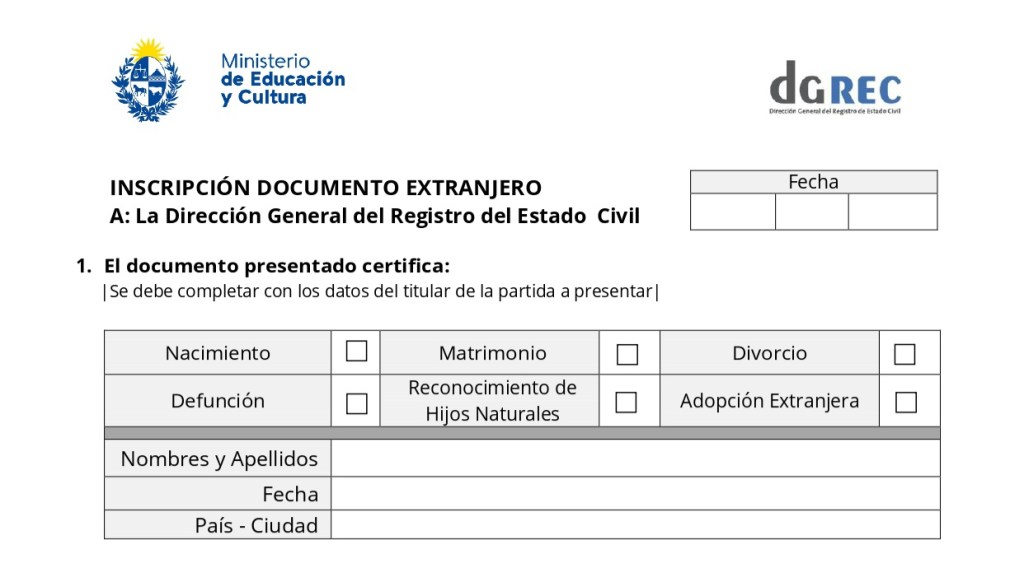
Uruguay requires the registration¹ of your Birth Certificate (and Marriage, Divorce Sentence, Adoption, Child Acknowledgement and/or family member’s Death if applicable) in order to issue you a full term ID (this applies to permanent and temporary residents alike) after you get your first provisional ID² (which doesn’t give you full temporary or permanent resident status).
The following is required:
- Certificate (less than an year old by the time of its submission).
- Apostille or Legalization from Uruguayan Embassy and Uruguayan Ministry of Foreign Affairs.
- Uruguayan Translation (if written in a foreign language).
- Uruguayan Notary’s Copy.³
- Color photocopy of the aforementioned items.
- Color photocopy of your Uruguayan ID⁴ or passport.
- Registration form for each certificate (which can authorize a third party).⁵
- Printout or email of each one of your certificate registration appointments.⁶
- ²The Civic Registry’s registration fee per certificate (1320 UYU) (it isn’t included).
¹The Civic Registry (‘Dirección General del Registro del Estado Civil’ in Spanish) is suffering a significant 8-12 backlog. Therefore it’s best if you authorize a third party to perform the registration on your behalf to receive your Uruguayan equivalent by the time you arrive to Uruguay.
²You’ll need your foreign Certificate + Apostille + Uruguayan Translation (if applicable) or your Uruguayan equivalent for your first ID. Once you have your provisional ID you can submit the registration request and wait for the Civic Registry to issue your Uruguayan Certificate for your second (full temporary or permanent resident) ID.
³It’s required to retrieve your original documents after the registration is performed. The Civic Registry will keep the Notary’s Copy for their records and release the originals back to you or your representative.
⁴You’ll be able to download your digital Uruguayan Certificate on the Civic Registry’s website after the registration is performed. You must use your Uruguayan ID number to do so. If you submitted your passport you must write in the information featured on your original Certificate.
⁵Authorizing a third party allows you to get the process started from overseas by sending them the required documents by mail. They can also get in line to pick up your originals from the Civic Registry’s Legal Departament (‘Departamento Notarial’ in Spanish) once the registration is performed.
⁶Each Certificate must have its own registration appointment and each one of them will receive a file tracking number that will indicate their registration stage. It’ll be ‘Submitted’ (‘En Unidad’ in Spanish), ‘Awaiting’ (‘En Espera’ in Spanish) meaning that it’s been flagged for an error and it’s awaiting to be corrected or ‘Archived’ (‘Archivado’ in Spanish) meaning that the registration has been performed successfully.
 Aldo’s Relocation Service